Concordia Asset Management
Strategy and organisational decision-making

PILLAR 2 · STRATEGY AND RISK

Strategy and Risk

Understand how decisions shape execution, risk and value.

Organisations rarely fail to execute strategy because they lack plans or capable people. The challenge is what happens as strategic intent moves through functions, management layers and competing priorities. Decisions that are reasonable in isolation can collectively distort execution, create hidden risk and erode value.

Concordia makes those relationships visible, measures how consistently priorities and trade-offs are understood, and helps organisations improve execution using the systems and frameworks they already have.

FROM STRATEGY TO EXECUTION

Every strategy passes through human decisions.

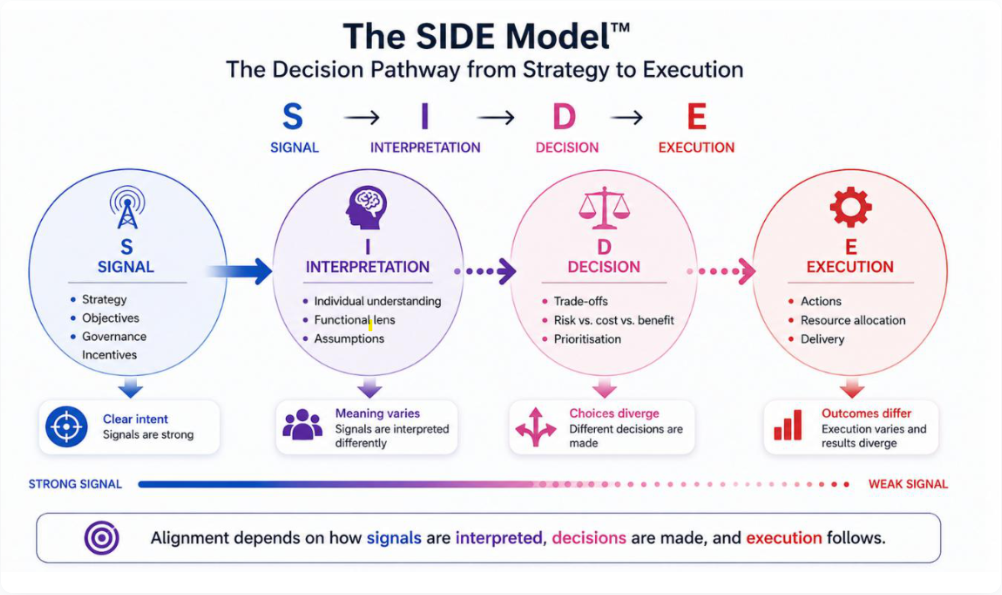
The S.I.D.E. model shows where a clear strategic signal can change as it moves through interpretation, decision-making and execution.

Complete S.I.D.E. model showing Signal, Interpretation, Decision and Execution, including how signals weaken along the pathway
Concordia's S.I.D.E. model — the decision pathway from strategy to execution.

A well-defined strategy does not ensure that different functions will interpret its implications in the same way. Local assumptions, incentives and resource constraints can change priorities and trade-offs long before performance measures reveal the consequences.

INVERSE AWARENESS

What leaders see and what operations know are not always the same.

Two perspectives, one organisational reality

At the strategic level, leaders have a clearer view of organisational direction, enterprise targets and capital trade-offs, but less visibility of local operational dependencies and constraints.

At the operational level, teams see equipment condition, workarounds, emerging failures and day-to-day fragility, but may have less visibility of enterprise priorities and the consequences of local decisions.

The risk instability zone

Information is filtered, risks are simplified and priorities are translated between these levels. Where tactical risks exceed leadership's awareness, or strategic trade-offs exceed operational capacity, instability can accumulate unnoticed.

When tolerance is exceeded, organisations become reactive: firefighting increases, decisions are delayed, costs rise and execution drifts from intent.


THE HIDDEN CONSEQUENCE

Complexity creates value. Poor coordination increases its cost.

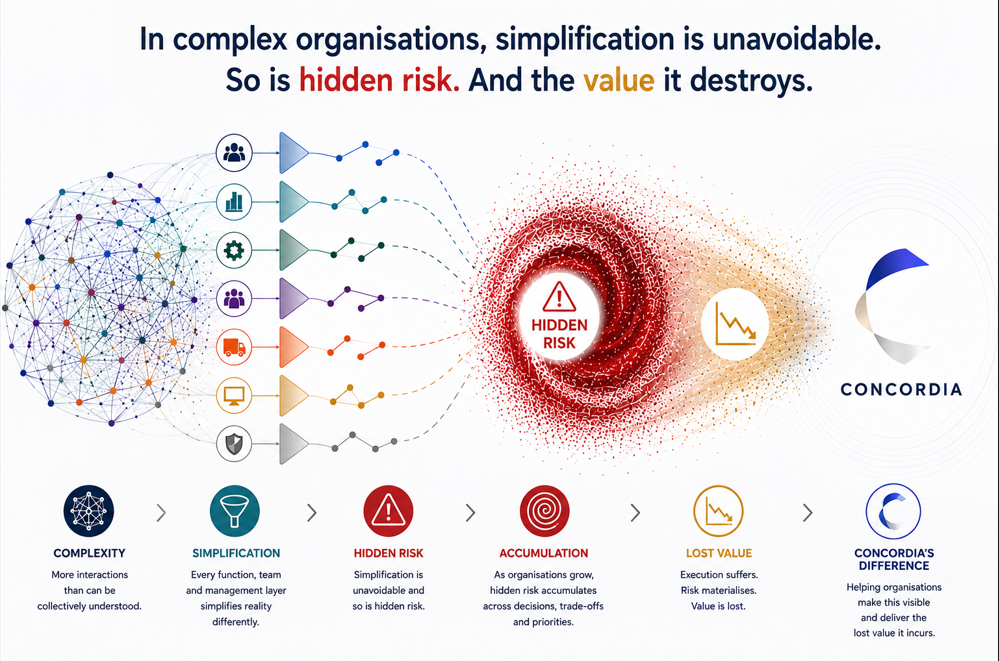
In complex organisations, simplification is unavoidable. The risk is what gets lost as different functions interpret reality through their own priorities and constraints.

Concordia concept visual showing organisational complexity being filtered into different information streams, accumulating hidden risk and leading to lost value
Complexity

More interactions, dependencies and specialised decisions create value, but increase the coordination burden.

Simplification

Functions and management layers filter information differently to make decisions manageable.

Hidden risk

Dependencies and emerging exposures become less visible across the organisation.

Accumulation

Risk builds through repeated trade-offs, deferred decisions and competing priorities.

Lost value

Rework, reactivity, inefficient capital use and weaker execution erode performance.

FRAMEWORK AGNOSTIC

We work with your strategy — not a replacement framework.

Concordia's process is agnostic to the strategy, management system or execution framework an organisation uses.

01

A documented intended strategy

The objectives and outcomes the organisation is seeking to deliver.

02

Expected behaviours

The decisions, priorities, trade-offs and ways of working expected to support that intent.

These provide the reference point for assessing what the organisation is actually doing. Concordia examines the differences between intended and practised decisions, rather than imposing a new strategy or additional management framework.

HOW CONCORDIA HELPS

Understand. Assess. Improve. Realise Value.

A continuous cycle connecting intended strategy, decision behaviour, execution improvement and measurable outcomes.

01

Understand

Clarify documented strategy, intended outcomes, expected behaviours and the systems and constraints shaping delivery.

02

Assess

Examine how signals are interpreted and decisions made. Identify coordination gaps, hidden risk and indicative value opportunity.

03

Improve

Align decision governance, incentives, priorities and cross-functional execution with intended outcomes.

04

Realise Value

Monitor performance, risk and financial outcomes. Learn, adapt and sustain improvement.

Continuous
improvement
Learn → Adjust → Act → Measure

Each cycle informs the next. Improvements are tested against delivered outcomes, not simply completed activities.

WHAT WE DELIVER

Strategy and Risk Services

Services can be delivered as a focused diagnostic, targeted improvement program or integrated strategy execution engagement.

01

Strategy Development

Develop clear strategic intent and SMART objectives, supported by a practical review of organisational skills, structure, systems, leadership and ways of working. Identify the capabilities and conditions needed to execute the strategy.

02

Coordination Assessment

Examine interpretation, decision tendencies, trade-offs and alignment across functions and management levels.

03

Strategy Execution & Optimisation

Assess and improve how strategy translates into decisions, priorities and operational activity. The approach works with any strategy or execution framework, provided intended objectives are documented and expected decision behaviours are defined.

04

Strategic & Enterprise Risk

Identify enterprise and execution risks, including system constraints, competing priorities and incentives that impede strategic delivery. Connect emerging operational exposure with organisational objectives and risk tolerance.

05

Governance and Decision Architecture

Review decision rights, escalation, accountability and governance rhythms. Align systems, constraints and incentives with intended decision behaviours, and make decision tendencies and trade-offs visible across functions.

06

Value Realisation & Continuous Improvement

Establish measures and feedback to assess whether improvements produce sustained outcomes.

Let's discuss your strategy execution challenges.

Understand where decisions diverge from intent, where risk accumulates and where value can be recovered.

Start a Conversation