Value across the organisation
Understanding the connections between capabilities, resources, risk, performance and long-term value — not treating functions or asset types in isolation.
Concordia was established around a practical question: how do organisations coordinate their decisions to realise the value they intend?

Concordia grew from a simple observation: organisations can have capable people, sound strategies and established processes, yet still struggle to make decisions that deliver the value they intend.
That observation comes from experience at every level of an organisation — from maintenance planning and frontline operations to engineering and asset management leadership, commercial decisions and executive discussions. Each level sees different priorities, constraints and consequences. What appears sensible in one part of a business can create costs, risks or missed opportunities elsewhere.
The original insight was the importance of coordination: connecting technical and commercial realities, aligning decisions with organisational objectives and understanding the trade-offs required to sustain performance. Concordia was established to make that connection practical.
Organisations create value through more than their physical or financial assets. Their performance depends on how productive, financial, enabling and demand-generating assets work together — including people, knowledge, technology, intellectual property, reputation and the systems that support them.
Managing each part well is not enough. The decisions that allocate resources, reconcile competing objectives and respond to uncertainty determine whether the organisation as a whole can create and sustain value.
Understanding the connections between capabilities, resources, risk, performance and long-term value — not treating functions or asset types in isolation.
Examining how cognition, emotion, organisational systems and incentives influence priorities, judgement and the trade-offs people make.
Identifying where decisions diverge from strategic intent, where constraints create hidden consequences and how existing organisational arrangements can work better together.
This interpretation is applicable wherever decisions and resources must be coordinated: across operations, investment, strategy, risk and leadership. Asset Management provided an important starting point, but the underlying challenge — and the opportunity to improve it — extends across the enterprise.
Better visibility of the decisions, trade-offs and constraints that already shape performance.
Concordia works with an organisation's existing strategies, governance arrangements, processes and management systems. The focus is on understanding how they operate together in practice, where decisions diverge from declared intent and what can be improved.
Its coordination work connects organisational objectives with the human and systemic influences on decisions. This helps make hidden exposure and opportunities for value realisation more visible, without requiring organisations to replace the frameworks they already use.
Cognition — how information is interpreted and assumptions are formed.
Emotion — how uncertainty, pressure and perceived consequences affect judgement.
Systems — how structures, processes and constraints shape available choices.
Incentives — what the organisation rewards, reinforces or discourages in practice.
Concordia’s work is grounded in practical engagement with leaders and practitioners, examining how decisions are made, how priorities compete and how those choices influence outcomes.
Concordia applies its experience across complementary fields, linking operational reality, investment exposure and strategic decision-making.
Improving the decisions that connect asset performance, reliability, risk, expenditure and long-term value.
Bringing visibility to underlying physical and organisational exposures that can influence investment and portfolio decisions.
Connecting strategic intent with organisational capability, risk, decision-making and execution.
Exploring how leadership, judgement and the systems people create influence collective outcomes.
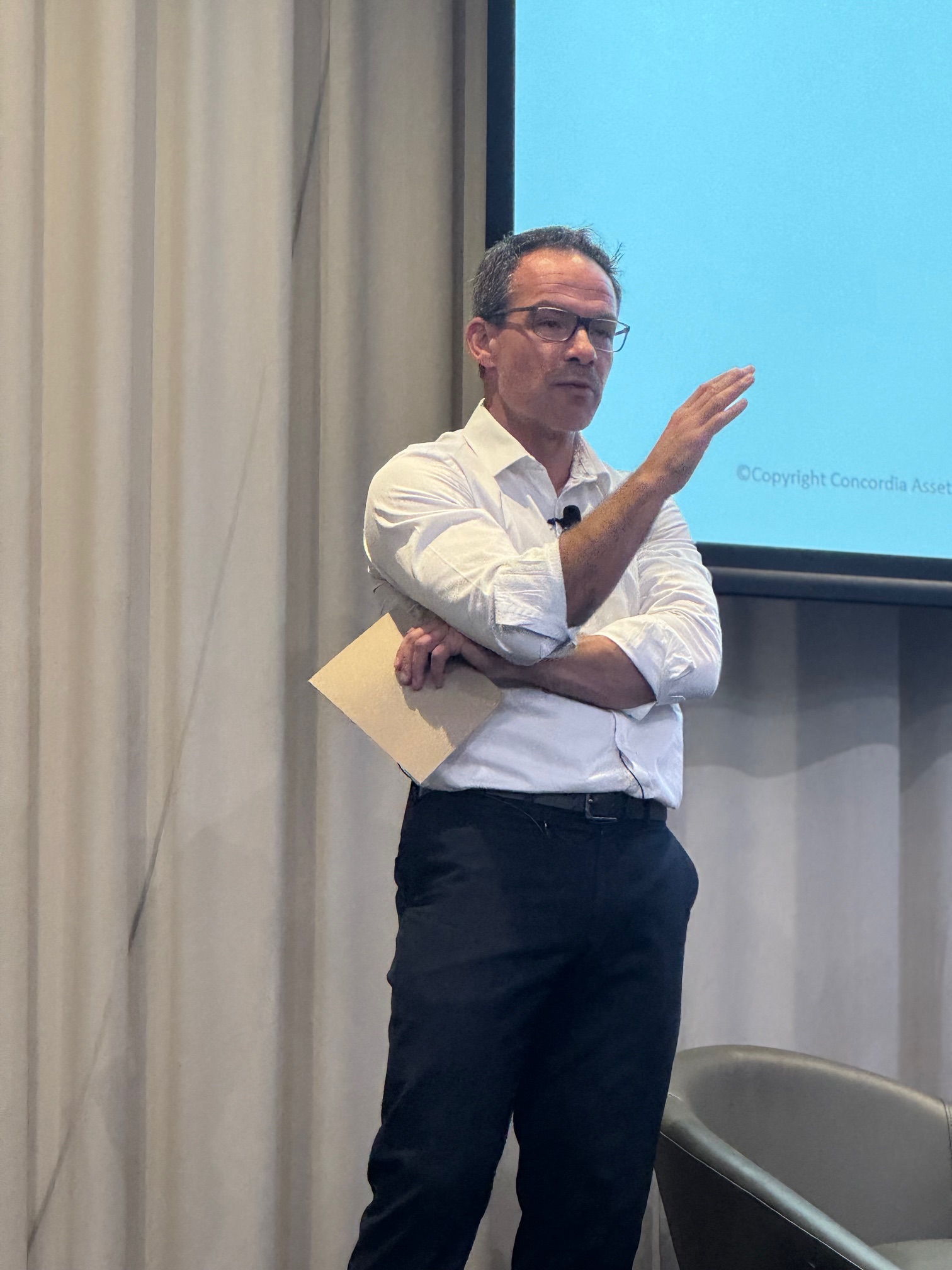
Travis brings more than 25 years of experience spanning the practical, technical, commercial and leadership dimensions of organisational performance. His career began in maintenance planning and progressed through maintenance management, national engineering and asset management leadership in major manufacturing organisations.
He has led large operational teams, worked closely with finance and commercial executives, and participated in executive leadership development. Later, as a senior consulting leader and founder of Concordia, he worked with organisations across manufacturing, healthcare, energy, water, transport, defence and institutional investment.
Having worked from the operational frontline through to executive-level discussions, Travis understands why different parts of an organisation can reach different conclusions about the same problem. This experience underpins Concordia's approach: combining technical and commercial understanding with insight into leadership, human judgement and organisational systems to improve the decisions that determine results.
Travis holds an MBA from Melbourne Business School.

Explore how better visibility of decisions and coordination can support your organisation's objectives.